Branded residences in Dubai: why OMNIYAT is a different league
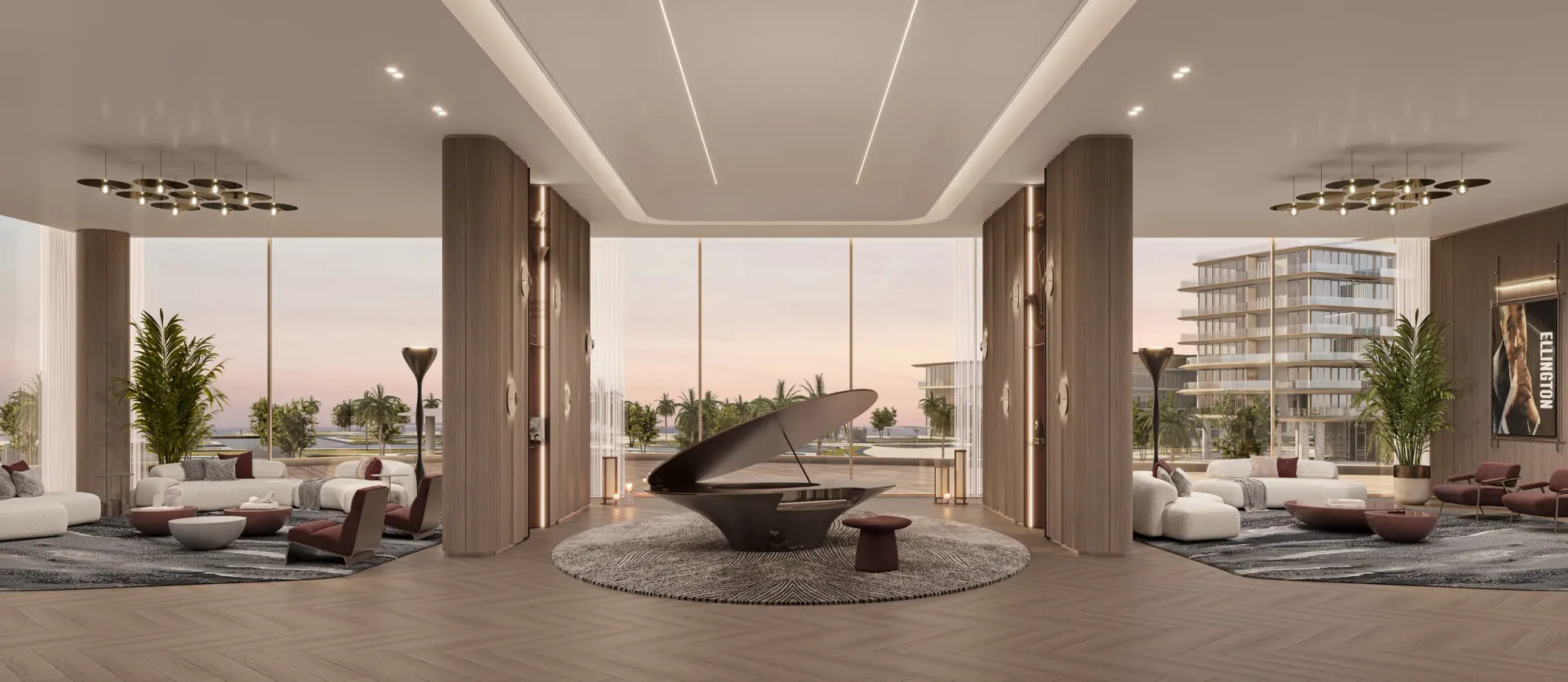
When a client asks me whether Dubai is overheated, I answer that it depends which Dubai we are talking about. Mass off-plan in JVC and a Dorchester Collection residence on Marasi Bay are two different markets, even though they sit in the same city. One is facing a wave of new supply, the other is largely immune to it. I’ll start with what these branded residences actually are, and finish with what this segment does not give you — because that has to be said too.
For full transparency: I am an OMNIYAT broker partner. That is exactly why I talk all the more about the weak points of this segment, because if I am to be credible, I cannot sell you renders alone.
What a branded residence is and what you really buy
A branded residence is an apartment signed off on and usually managed by a brand, most often a hotel or fashion house: Dorchester Collection, Bulgari, Aman, Armani. The brand is responsible not only for the name on the door, but for the design, the finish standard and — most important for an overseas owner — the hotel service. You buy an apartment, but you also get an operator who looks after the building and your unit when you’re away.
This is not merely a prestigious address. It is a product in which someone else takes on the management and the quality.
What the premium pays for
Branded residences cost more than a comparable apartment without a brand. How much more? Here you have to be careful with the numbers that circulate online. The global median premium is around 33 percent (Savills 2025/2026), and the typical range in the prime segment is 20 to 35 percent (Knight Frank). In Dubai, at the strongest addresses, the premium can reach considerably higher — figures as high as 69 percent are quoted — but that is the top end for individual, exceptional projects, not the rule. The honest number to remember is 30 to 40 percent.
What does that premium pay for? For three things. For liquidity in the upper segment, because a recognisable brand is easier to sell to a global buyer. For a quality guarantee in a market where developer quality can be uneven. And for turnkey management, which for an owner living in Poland is not a luxury but a condition of peace of mind.
OMNIYAT: fewer projects, greater depth
OMNIYAT has been operating since 2005 and, in the first half of 2025, led transactions above USD 10 million in Dubai. Its philosophy is the opposite of the mass developers’: it doesn’t build a lot, it builds exceptionally. It works with Zaha Hadid Architects, with Foster and Partners, and hands its properties over to Dorchester Collection to manage.
Its residential portfolio includes, among others: The Opus (the Zaha Hadid landmark in Business Bay), The Lana Residences, ORLA and ORLA Infinity on Palm Jumeirah, AVA on the Palm with just 17 residences, and VELA and VELA Viento on Marasi Bay. These are apartments. (For the record, I’ll add that OMNIYAT also builds office towers in Business Bay, like LUMENA and ENARA, but that is a separate, commercial segment, not residences.)
Why The Lana is proof, not a render
In a market where a significant share of off-plan projects run late, the strongest argument is not a visualisation but a delivered building. The Lana Residences, Dorchester Collection, is exactly that kind of proof. The hotel opened in 2024 — it is Dorchester Collection’s first address outside Europe and the United States. Handover of 39 residences to owners has already begun, and the brand genuinely manages the property.
This is not a promise for 2027. It is a working building you can visit. When I assess a developer’s credibility for a client, a delivered project with a real operator weighs more than any brochure.
Resistance to oversupply, or why this segment plays differently
The wave of new supply in Dubai is real. There is talk of more than 150,000 homes to be delivered between 2025 and 2027, and Fitch forecasts a price correction of up to 15 percent. But both Fitch and Moody’s point to the same thing: the impact is concentrated in the mass apartment segment, in districts like JVC and Business Bay, where the most studios and one-bedroom units are being built.
Ultra-prime plays differently, because its supply is structurally limited. The number of listings above USD 10 million fell by about 65 percent over the year, to roughly 460 properties across all of Dubai. Only 46 percent of promised housing was delivered on time. A Dorchester residence with 39 apartments and AVA with 17 residences simply do not compete for the same buyer or tenant as a mass tower in JVC. By comparison, the prime segment grew 25 percent in 2025, and the forecast for 2026 is admittedly only around 3 percent — but still growth, while the mainstream is forecast at around 1 percent.
This does not mean it is a risk-free investment. It means it is a different market from the mass one, with its own risk profile.
What this segment does not give you, honestly
A premium of 30 to 40 percent is not a premium for higher rental income. Quite the opposite. The yield in this segment is low, usually 4 to 5.6 percent gross, while mass apartments deliver 6 to 7. If someone is selling you a Dorchester on the basis of rental returns, they are selling you the wrong thing. This is a play for capital preservation, prestige and service, not for cash-flow.
The second thing is liquidity. The very rarity that protects the price also means a narrow resale market. There are few buyers for a trophy worth tens of millions of dirhams, so exiting the investment can be slower and depends on finding the right buyer. This is not a product for a quick flip.
And third: even prime can correct. The boom is slowing, the forecasts for 2026 are now single-digit percentages, not twenty-something. Prime is more resilient, but not fully immune.
Who it makes sense for
Branded ultra-prime makes sense for someone who wants to place capital in an asset resistant to the wave of mass supply, values prestige and a recognisable address, and wants someone else to manage the property while they are in Poland. It does not make sense for someone seeking maximum yield and quick liquidity, because then this segment will be a disappointment.
My role is not to sell you a unit. It is to give an honest assessment of whether this segment fits what you are really looking for, and to show you a realistic exit path before you go in.
If you are considering a specific OMNIYAT project, or wondering whether a branded residence fits your goal, write to me. I’ll show you the units currently available and give an honest assessment of the upsides and the risks, including what a real resale looks like.
This post is informational in nature and does not constitute an investment recommendation or an offer within the meaning of the law. Project prices are an order of magnitude, as of June 2026, and are subject to change. Market forecasts (Fitch, Knight Frank) are scenarios, not certainties.